
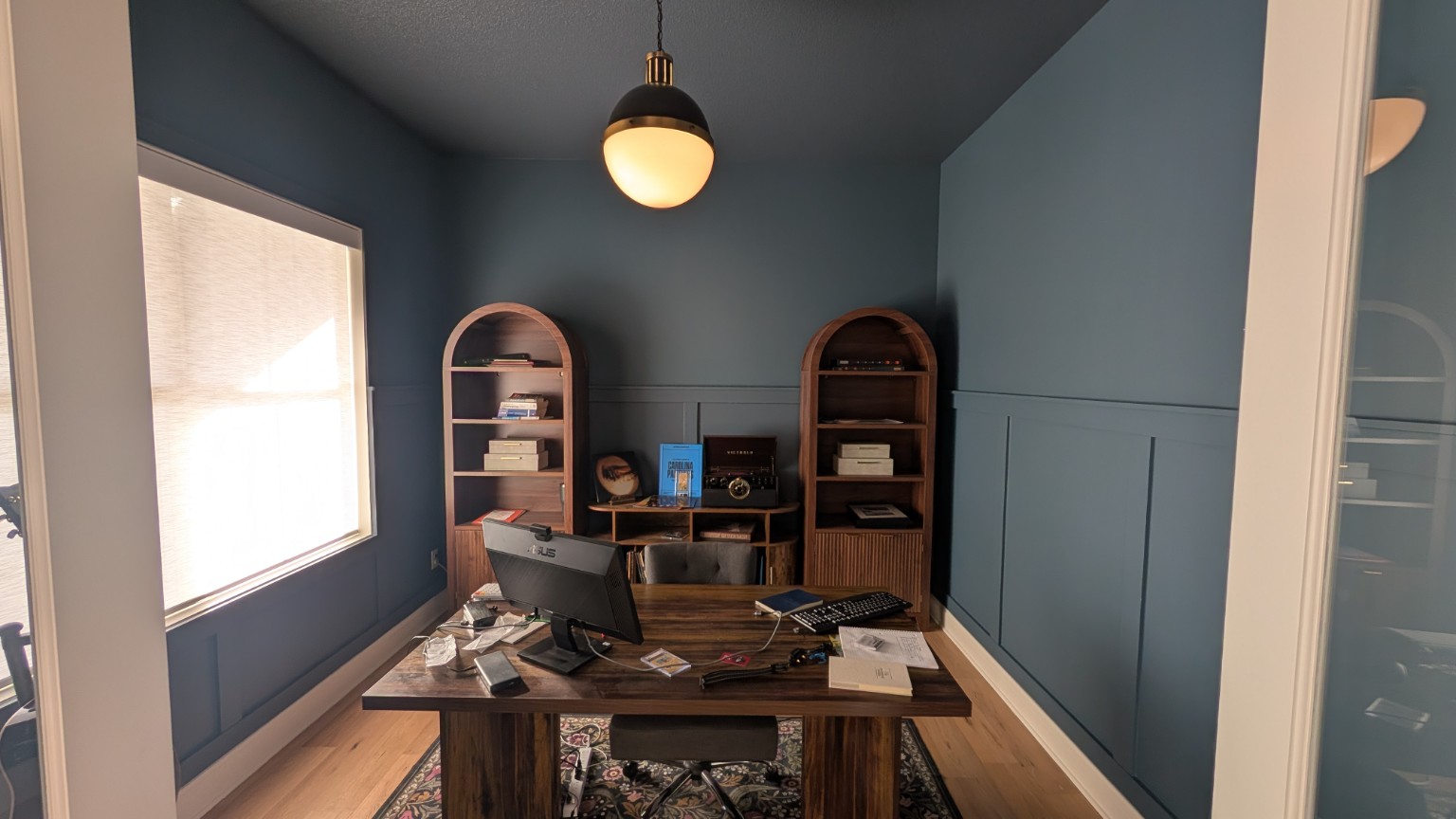
A home office shared by Love Your Home illustrates how deep wall color, paneling, and a dark ceiling can work together. The paint color and sheen have not been identified.
Want a room to feel more cohesive, cozy, or full of character? Color drenching brings paint beyond the walls, using one color—or closely related shades—across several parts of a room. It is a useful option to consider when planning an interior painting project in Andover, Ramsey, or the surrounding northwest Twin Cities.
What is color drenching?
A full color-drenched room often carries the same color across walls, ceiling, trim, and doors. Some designs extend it to built-ins or cabinetry. A softer version uses different shades within one color family, creating subtle variation while keeping the room connected.
You can also adapt the idea to the details you want to keep. In the office pictured here, blue-gray walls and board-and-batten paneling pair with a dark ceiling. White trim and natural wood furniture provide contrast. It is a good example of borrowing the enveloping effect without painting every surface the same color.
Why is it popular right now?
Color drenching is part of current design conversations: Sherwin-Williams discusses it in its 2026 color guidance, and Benjamin Moore features both single-shade and tonal monochromatic rooms.
Its appeal is easy to see. Repeating a color creates fewer abrupt visual transitions between surfaces. That can make an office feel more settled, a bedroom more restful, or a dining room more intimate. The result depends on the room, light, and color; a deep shade creates a different atmosphere from a soft neutral.
A unified paint palette also gives furniture and materials room to stand out. In this office, the warm wood shelves and desk remain distinct against the blue-gray background. Paneling adds another layer through its shape and shadows.
Does color drenching have to be dark?
No. Rich blues, greens, and browns can create a dramatic setting, but warm neutrals and lighter shades can also carry the idea. The starting point should be the atmosphere you want and the finishes you already have: flooring, cabinetry, furniture, and lighting.
Choose the finish for each surface
Using the same color does not require using the same paint product or sheen everywhere. Different finishes can add subtle contrast, and the coating should suit the surface and its cleaning needs. Walls, doors, trim, and cabinets deserve a plan of their own, even when they share a color.
Plan the whole room before painting
Decide which surfaces will receive color and which will remain contrasting. Test physical samples beside your flooring and furniture, and check them in daylight and under your evening lighting. Include the ceiling in that decision: it receives light differently from the walls, so the same shade may look different overhead.
Start with a room you can picture using every day. An office, bedroom, or dining room gives you a defined space to explore the look. Good preparation and a clear plan for edges, paneling, and trim help the finished design feel intentional.
Bring the idea home
Love Your Home provides interior painting, cabinet refinishing and coatings, and accent-wall work for homeowners in Andover, Ramsey, Elk River, Coon Rapids, Oak Grove, and nearby communities. If you are considering color drenching, request a free estimate or call 763-300-5834 to talk through your project.
See more inspiration in our project gallery.
References: Benjamin Moore: Monochromatic Color Schemes; Sherwin-Williams: A Single-Hue Haven; Sherwin-Williams: Designers Decode Our 2026 Color of the Year. Published November 4, 2026.